This class is a high level interface added to ease testability of component that use Executor. It decouples Excecutor and syscalls used to handle requests thus behaving like an OS abstraction layer. More...
#include "utils/command/executor/IOsal.h"
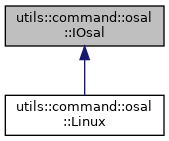
Public Types | |
| enum | ProcessId : unsigned int { CHILD = (1u << 0u), PARENT = (1u << 1u) } |
| An id to inform caller about the current process type after a new process has been created. More... | |
Public Member Functions | |
| IOsal ()=default | |
| virtual | ~IOsal ()=default |
| IOsal (const IOsal &)=delete | |
| IOsal & | operator= (const IOsal &)=delete |
| IOsal (IOsal &&)=delete | |
| IOsal & | operator= (IOsal &&)=delete |
| virtual ProcessId | createProcess () const =0 |
| creates a new process by duplicating the calling process. More... | |
| virtual void | waitChildProcess () const =0 |
| Wait for any child process whose process group ID is equal to that of the calling process. More... | |
| virtual void | executeProgram (const char *pathname, char *const argv[], char *const envp[]) const =0 |
| Execute the program referred to by pathname. More... | |
| virtual void | reseedPRNG () const =0 |
| Initialize the Random Number Generator for a new sequence of pseudo-random integers to be returned by rand() More... | |
| virtual void | sanitizeFiles () const =0 |
| Close all opened file descriptors except those related to the standard streams (stdin, stdout, stderr). These are reopened to /dev/null if not already opened. More... | |
| virtual void | dropPrivileges () const =0 |
| Permanently drop the privileges of the process. More... | |
Detailed Description
This class is a high level interface added to ease testability of component that use Executor. It decouples Excecutor and syscalls used to handle requests thus behaving like an OS abstraction layer.
- Note
- Copy contructor, copy-assignment operator, move constructor and move-assignment operator are defined to be compliant with the "Rule of five"
- Date
- May 2020
Member Enumeration Documentation
◆ ProcessId
| enum utils::command::osal::IOsal::ProcessId : unsigned int |
Constructor & Destructor Documentation
◆ IOsal() [1/3]
|
default |
Class constructor
◆ ~IOsal()
|
virtualdefault |
Class destructor
◆ IOsal() [2/3]
|
delete |
Class copy constructor
◆ IOsal() [3/3]
|
delete |
Class move constructor
Member Function Documentation
◆ createProcess()
|
pure virtual |
creates a new process by duplicating the calling process.
It can basically be a wrapper of fork() call in linux.
- Returns
- An id of type ProcessId
Implemented in utils::command::osal::Linux.
◆ dropPrivileges()
|
pure virtual |
Permanently drop the privileges of the process.
Implemented in utils::command::osal::Linux.
◆ executeProgram()
|
pure virtual |
Execute the program referred to by pathname.
It can basically be a wrapper of a exec()-like function. It is expected it does not return unless an error is encountered.
- Parameters
-
pathname Either a binary executable, or a script starting with a line of the form: "#! interpreter [optional-arg]" argv An array of argument strings passed to the new program. By convention, the first of these strings should contain the filename associated with the file being executed. envp An array of strings of the form key=value, which are passed as environment to the new program.
Implemented in utils::command::osal::Linux.
◆ operator=() [1/2]
Class copy-assignment operator
◆ operator=() [2/2]
◆ reseedPRNG()
|
pure virtual |
Initialize the Random Number Generator for a new sequence of pseudo-random integers to be returned by rand()
Implemented in utils::command::osal::Linux.
◆ sanitizeFiles()
|
pure virtual |
Close all opened file descriptors except those related to the standard streams (stdin, stdout, stderr). These are reopened to /dev/null if not already opened.
Implemented in utils::command::osal::Linux.
◆ waitChildProcess()
|
pure virtual |
Wait for any child process whose process group ID is equal to that of the calling process.
It can basically be a wrapper of waitpid() call in linux with a pid equal to 0.
- Note
- This method raises an exception when the child process failed
Implemented in utils::command::osal::Linux.
The documentation for this interface was generated from the following file:
- /workdir/src/utils/command/executor/IOsal.h